Designing an Explosion-Proof Metal Detector for a Leading Eyeglass Lens Manufacturer
Project Background
An internationally leading eyeglass lens manufacturer required a metal detection and sorting line for its production facility. The project presented three challenges: explosion-poof compliance, product fragility, and precise positioning for sorting. A standard metal detector could not address them. The system was delivered and has since been put into production on the client’s line.
Challenges
Explosion-proof requirements. The client’s workshop operates under strict explosion-proof requirements, so the system could not be a standard metal detector. Lens production involves volatile organic solvents used in coating, cleaning, and edge-processing steps, and these solvents give off flammable vapor. In a confined workshop with poor ventilation or an accidental release, that vapor can accumulate and form an explosive atmosphere. The system therefore had to be built to explosion-proof standards, not merely made robust.
Product fragility. Eyeglass lenses scratch easily, cannot be bumped, and tend to pile up and jam if mixed together on a conveyor belt.
Positioning accuracy. The sorting section required consistent positioning. If a lens drifted even slightly during conveying, the pusher would misfire. Therefore, this will lead to decrease sensitivity and affect metal contamination detection.
The design therefore had to address three challenges at once: electrical safety, mechanical damage, and positioning error.
Solution
1. Custom Explosion-Proof Control Box
The system had to be safe for a complex, regulated environment, so an explosion-proof control box was custom-built rather than adapted from a standard unit. This was a compliance requirement first, but it also provided a stable and reliable foundation for the rest of the system. Designing for explosion-proof conditions from the beginning is considerably easier than retrofitting, because it affects cable routing, component selection, and enclosure design simultaneously.
2. Cleated Conveyor Belt Instead of a Flat Belt
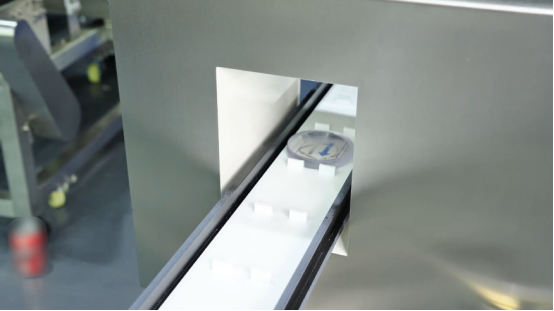
This was the key mechanical change. A conventional flat conveyor belt allows lenses to touch each other, causing scratches, and when parts accumulate at a stop point they stack and jam. A cleated conveyor belt was adopted instead, so each section between cleats holds an individual lens. That single changes solved three problems at once: no collisions between lenses, no stacking at the sorting section, and a predictable position for every lens entering the detection and sorting section. It also improved downstream detection reliability, because each lens arrives at a fixed position rather than wherever it happened to settle.
3. Plastic Limit Blocks at the Sorting Section
Even with cleats, a lens can drift sideways during conveying, and any misalignment throws off the pusher’s timing and reach. Plastic limit blocks were add on both sides of the conveyor belt just before the sorting device. The plastic material was chosen deliberately. It guides the lens without scratching it. When the conveyor belt stops, the lens sits precisely in front of the pusher, and the push-out action is repeatable recycle after cycle.
Key Design Takeaways
1. Separate fragile parts physically. For fragile, scratch-sensitive parts, separating them physically on the conveyor belt is often better than trying to slow down or cushion o shared belt.
2. Fix positioning upstream. Sorting usually depends on what happens upstream of the pusher, not on the pusher itself. Fix the positioning first, and the detection becomes simple.
3. Design for explosion-proof conditions from the start. Explosion-proof requirements affect the whole system, not just the control box, so it pays to design for them from the beginning rather than treating them as an add-on.
4. Small details such as plastic limit blocks can do more for reliability than complex active controls, and they cost far less to maintain.
To discuss a similar handling or sorting challenge in your own line, contact our engineering team.
This project combined explosion-proof control design, a cleated conveyor belt for fragile lens hand ling, and limit blocks for repeatable sorting positioning. The result was a detection and sorting line that met the client’s electrical safety requirements while protecting the product and maintaining consistent sort precise.