


How to Overcome the “Product Effect” in Hotpot Soup Base Metal Detection
The global popularity of hotpot culture has led to a booming market for pre-packaged hotpot soup bases. From rich, spicy beef tallow to savory tomato and mushroom broths, these products require absolute food safety before hitting supermarket shelves world wide. However, for food manufacturers, inspection hotpot soup base packets for foreign metal contaminants presents a notorious technical challenge: the massive “product effect”. At COSO, we recently showed how our metal detector effortlessly handles plastic-packed hotpot bases, filtering out false alarms while catching metal fragments with high precision.
The Challenge: Why Hotpot Base Tripped Traditional Metal Detectors
Hotpot soup bases are dense, moisture-rich, and heavily loaded with salt, spices, and fats. When these ingredients pass through the high-frequency electromagnetic field of a standard metal detector, they conduct electricity and generate a strong magnetic response. This phenomenon is known as the “product effect”.
High Conductivity: The high salt (NaCI) content acts like a magnet conductor, mimicking the signal of actual metal contaminant.
Temperature Fluctuations: Hotpot bases packed when warm or frozen will exhibit completely different product signals, causing traditional machines to trigger constant false rejects.
Packaging Material: Many premium soup bases are sealed in aluminum film, which completely blinds standard coil systems.
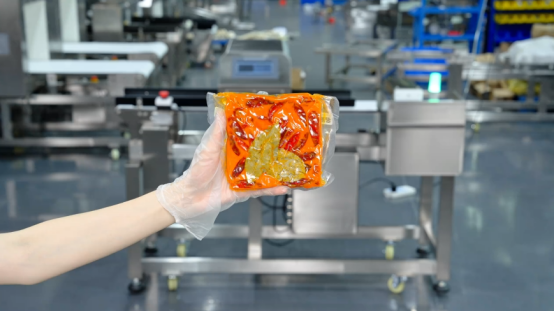
Hotpot base
The COSO Solution: Intelligent Technology Built for Complex Foods
To solve this, the COSO metal detector utilizes multi-frequency digital signal processing and self-learning algorithms to detect this soup base itself while keeping high precision.
- Auto-Learning & Product Effect Compensation
Our system can automatically learn this product feature. By passing a clean hotpot packet through the tunnel, the machine analyzes it, maps the specific moisture, salt signature, and completely counteracts the product effect.
- Multi-Frequency Digital Processing
Instead of relying on a single frequency, COSO adapts its electromagnetic wave frequencies based the product type. This enables precise detection of both ferrous (Fe) and non-ferrous (copper, aluminum) metal contaminants, as well as non-magnetic stainless steel commonly rubbed off from cooking vats.

1.0 mm ferrous in the hotpot base
Streamlining Your Packaging Line
As showcased in our viral video, the conveyor integration allows seamless positing right after the primary packaging and before case packing. When a contaminant is detected, customizable rejection system (such as pusher rejection, drop-belt rejection, drop-flap rejection) instantly reject the defective packets without slowing down your throughput.


