


Conveyor Needle Detector for Textile
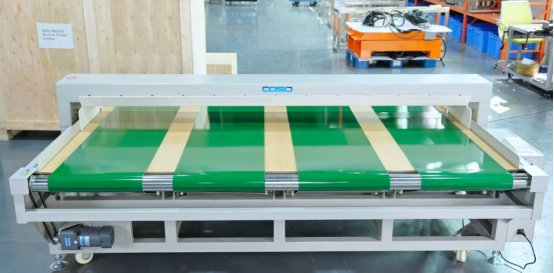
The textile and fabric manufacturing industries face persistent challenges regarding product safety, specifically contamination from broken needles or metal fragments. This case highlights the application of the wide conveyor needle detector, a specialized industrial inspection system designed for wide-format materials. By deploying an extra-wide conveyor belt (2350 mm), height (120 mm), manufacturers can automate quality control for bulky items like bedding, mattresses, and non-woven fabrics, significantly reducing product recall risks and protecting consumer safety.
When the metal contaminant is detected, the belt can rewind or stop with an alarm.
Industry Applications
The wide needle detector is engineered specifically for large-scale, wide-width textile manufacturing lines where standard conveyor belt metal detectors fail to detect.
Ideal Product Material
- Home Textiles: Bedding sheets, quilts, comforters, and full-sized mattresses.
- Industrial & Technical Fabrics: Non-woven fabrics, artificial leather, and synthetic textiles.
- Padded & Layered Goods: Needle-punched cotton and spray-bonded cotton insulation/padding.
Problem Statement & Automated Solution
The Broken Needle Dilemma in Garment & Textile Manufacturing
During high-speed industrial sewing, quilting, or needle-punching, needles frequently fracture. Finding fragmented metal pieces manually in high-volume production lines is virtually impossible, This may bring severe consumer safety liabilities and potential lawsuits. Damage to downstream processing machinery (e.g., cutting blades, rollers).Brand reputation damage and costly batch recalls.
The Automated Solution
Integrating the COSO wide needle detector directly into the end-of-line packaging or post-quilting phase solves this vulnerability.
How it works: As materials pass through the conveyor belt, sensors scan the entire volume. The moment a metal fragment is flagged, the system instantly triggers an alarm. Depending on factory configuration, the conveyor belt will either stop immediately or automatically rewind the material to allow operators to locate and extract the contaminant safely.
What factors affect needle detector performance?
Several factors can influence the detection sensitivity and overall performance of a needle detector, including:
1. Product size and thickness – Larger or thicker products may reduce detection sensitivity.
2. Metal contaminantssize, type, and orientation – Smallermetal contaminantsor certain positions may be more difficult to detect.
3. Conveyor height and inspection area – Increased detection distance can affect sensitivity.
4. Machine calibration and settings – Improper setup may lead to missed detections or false alarms.
5. Environmental interference – Electrical noise, vibration, temperature fluctuations, or nearbymovablemetal objects can impact performance.
6. Conveyor speed – Excessive speed may affect detection accuracy.
7. Equipment condition and maintenance – Regular calibration, testing, and maintenance are essential for reliable performance.


